

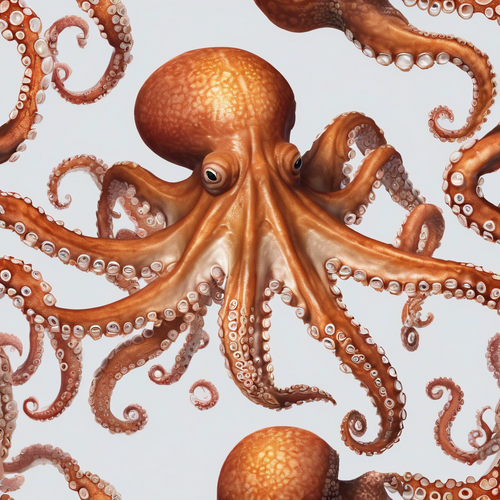
Octopuses’ 8 Arms Snoop on the Microbial World
In the depths of the ocean, where sunlight struggles to penetrate, an incredible drama unfolds, starring one of the sea’s most enigmatic creatures: the octopus. Known for their intelligence and adaptability, octopuses have evolved eight flexible arms that not only allow them to navigate complex environments but also to interact in remarkable ways with the microscopic life around them. 🐙✨
Research suggests that these fascinating marine animals engage in a form of “snooping,” using their arms not just for locomotion and hunting, but as investigative tools to probe microbial communities that flourish on the ocean floor. As they glide through their habitat, each arm becomes a specialized sensor, picking up chemical signatures and gathering data on their surroundings that goes far beyond mere sight.
The Microbial Ecosystem: A Hidden World
Underwater microbial communities play a crucial role in the overall health of marine ecosystems. These tiny organisms contribute to nutrient cycling, serve as a food source for larger marine animals, and even participate in the decomposition of organic matter. 🎉 Research led by marine biologists has shed light on how octopuses exploit these communities for survival and insight.
For instance, scientists have observed octopuses in various environments—seagrass meadows, coral reefs, and rocky substrates—actively sampling bacteria and microbial life using their sensitive suckers. Each sucker contains thousands of chemoreceptors, allowing octopuses to taste and smell their surroundings with astounding precision. 🦠
Arms as Explorers: The Mechanics of Snooping
With eight arms at their disposal, octopuses exhibit behaviors that highlight their mastery over complex movements and multitasking. When an octopus approaches a new environment, it often extends its arms to explore independently, sampling multiple areas simultaneously. This capability is particularly advantageous when foraging for food or assessing threats.
“The octopus is like an aerial drone in the ocean. Its arms act independently while communicating with the brain, processing environmental data rapidly,” explained Dr. Mia Hernandez, a marine biologist specializing in cephalopod behaviors. 🧠
Current research shows that octopuses can employ both active and passive chemosensory strategies. While actively probing surfaces, they also monitor the chemical trails left by prey or neighboring organisms. This dual approach increases their efficiency in locating food sources and understanding the microbial dynamics around them.
Beyond Dinner Plate: The Role of Microbes
The relationship between octopuses and microbial communities is not one-sided. The microbial life they interact with can influence octopus behavior and health, creating a vibrant feedback loop in this underwater ecosystem. Certain microbes may enhance the nutritional value of the octopus’s diet, while others may play roles in detoxifying harmful compounds, showcasing the intertwined fates of these organisms. 🍽️
Research Implications: Understanding Intelligence in Cephalopods
As researchers delve deeper into the snooping behaviors of octopuses, implications extend beyond marine biology. The octopus, with its unique neural architecture and adaptive behaviors, challenges conventional notions of intelligence. Its ability to process information from its environment through decentralized limbs provides fascinating parallels to artificial intelligence and robotics, shedding light on how intelligence can manifest in diverse forms across evolution. 🤖
With studies showing that octopuses exhibit problem-solving capabilities akin to those of some mammals and birds, understanding their interactions with microbes could illuminate further aspects of their intelligence. Scientists are particularly interested in whether these interactions possess elements of learned behavior, suggesting that octopuses may be capable of cultural transmission—an elusive trait in the animal kingdom.
Conservation and the Future of the Ocean’s Mysteries
As the world’s oceans face unprecedented challenges—climate change, pollution, and habitat destruction—the importance of understanding keystone species like the octopus grows immensely. Protecting the health of microbial ecosystems, in which these fascinating creatures play a critical role, is vital for maintaining the balance of marine life. 🌍
Conclusive research on octopus snooping can not only inform conservation efforts but also emphasize the necessity of preserving microbial diversity, which remains a cornerstone for marine ecology. Supporting policies that protect these ecosystems can ensure the longevity of species that contribute to our understanding of life itself.
In the grand tapestry of ocean life, the eight arms of the octopus serve as a reminder of the complex and beautiful interactions that define our planet’s health. From microbial detectives to intelligent problem-solvers, octopuses remind us just how much there is still to learn from the oceans’ depths.