

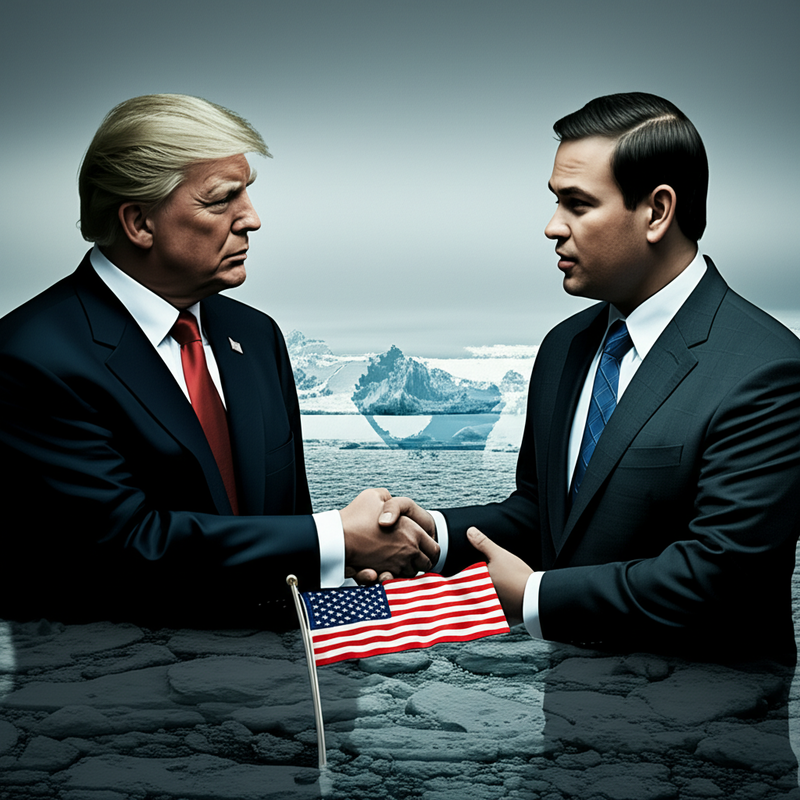
Rubio Told Lawmakers Trump Wants to Buy Greenland 🧊🇺🇸🇬🇱
It’s a truth stranger than fiction yet all too real in the kaleidoscopic theater of 21st-century politics: a sitting U.S. president reportedly pitched the billion-dollar purchase of Greenland — an island cold in climate but hot in strategic value. Senator Marco Rubio, traditionally a steady voice in conservative circles, became an unlikely herald of this Arctic aspiration when he disclosed to lawmakers that Donald Trump had entertained the idea of buying Greenland from Denmark. What can this bizarre episode teach us about modern geopolitics, American impulsiveness, and the curious dance of power on a frozen stage? ❄️🤨
A Dream of Ice and Empire
History’s stationery reminds us that territorial acquisitions in the modern age resemble tectonic plates — shifting slowly, under immense pressure, yet capable of sudden, unpredictable jolts. While the notion of purchasing an entire island in the 21st century may echo the distant echoes of the Louisiana Purchase or the Alaska Acquisition, the circumstances surrounding Greenland’s “sale” attempt carry a sharp antithesis: a billion-dollar real estate deal clashing with established international norms grounded in self-determination and sovereignty. These competing ideas, acquisition and diplomacy, sit side by side like icebergs — invisible bulk beneath, fragile peaks on display.
Rubio’s revelation wasn’t the first whiff of this audacious plan. News outlets had hinted at it, but his account gave credence amid Capitol Hill corridors, sparking laughter mingled with genuine bafflement. How does one reconcile a nation’s premier executive discussing territorial expansion with a nearly poetic simplicity despite the glaring diplomatic repercussions? It’s as if someone were trying to buy a glacier by offering pocket change. 🧊
The Greenland Gambit and Arctic Chess
Far beyond a transactional curiosity, Greenland is an island of immense strategic importance — its vast ice sheet hiding precious natural resources, a front line in the contest for Arctic dominance, and home to a population that is proud, autonomous, and increasingly assertive. The island sits literally at the meeting point of environmental urgency and geopolitical ambition, reminding us that the battle for control over the Arctic is less a calm chessboard and more a storm-tossed sea.
Denmark, Greenland’s sovereign nation-state, swiftly rebuffed the idea, characterizing the attempt as “absurd.” This response, while blunt, underscores a fundamental paradox — Greenland is not real estate ripe for sale but a homeland with evolving self-governance. The irony is striking: in an age when states agitate for independence and recognition, a seemingly cavalier offer to buy out a people’s rights reads less like diplomacy and more like colonial mimicry. Perhaps it’s a reminder that the ghosts of empire still haunt the corridors of power.
Rubio’s Role: Whisperer or Gatekeeper?
One might wonder: why would a seasoned senator volunteer this tidbit? Rubio’s disclosure casts him simultaneously as a bridge and a lightning rod. His candor toward fellow lawmakers provides a rare glimpse behind the curtain of executive deliberations often sealed tighter than Arctic permafrost. Yet one suspects his announcement was calculated, a move to stir awareness or perhaps caution in Congress about such unconventional maneuvers.
Behind the scenes, the whispers grow louder that Greenland’s significance transcends the snow and ice — it is a geopolitical jewel coveted by superpowers for its potential as a military outpost, an energy reservoir, and an access point to emerging Arctic shipping lanes. Rubio, in sharing this information, nudges the legislative branch toward vigilance and strategic cohesion amid a rapidly evolving global landscape.
“The irony is that in an era of drones, satellites, and cyber warfare, the purchase of physical territory still stirs debate — a relic yanked abruptly into the digital age’s spotlight.”
The Broader American Narrative
Rubio’s revelation fits oddly into the broader tapestry of American self-conception. The United States, historically a nation of expansion and reinvention, now shows shades of erratic ambition wrapped in casual audacity. Is this proposal a sign of geopolitical genius, a jest, or a symptom of political theatre? The contradiction bubbles up vividly — a world power with sprawling influence, yet tempted by nineteenth-century dreams of land acquisition, as if imperial maps were puzzles to be rearranged at whim.
It invites a rhetorical question: in a country founded on democratic ideals and respect for sovereignty, what does it mean when its leader contemplates buying neighbors like an oversized board game? The mental image resembles a billionaire child-heartedly eyeing new pieces in the global playground — the purchase promising power but risking dignity.
Lessons From the Ice
The story of the Greenland purchase proposal divulges more than legislative gossip. It reflects the entwined tensions between modern diplomacy and mercantilist instincts, between respect for indigenous peoples and the cold calculus of resource acquisition. Rubio’s programmatic disclosure unwittingly showcased these contradictions — an emblem of America’s restless quest for dominance amid a changing world order.
The frozen island remains off the market, a testament to sovereignty’s resilient frost. Yet the episode resonates like a glacier cracking under strain — signaling shifting alliances, emerging Arctic battlegrounds, and the enduring allure of geography in global power.
In this gripping narrative of ambition and rebuff, one is reminded that political fantasies can be as ephemeral and slippery as ice itself — beautiful, shimmering, and liable to melt when the sun of reality strikes. Perhaps the true lesson is that power, like ice, must be handled carefully, lest it fracture beneath too much weight.
Keywords: Trump Greenland proposal, Marco Rubio disclosure, U.S. Arctic strategy, Denmark-Greenland relations, territorial acquisitions, Arctic geopolitics, Greenland sovereignty, congressional reactions, diplomatic irony, 21st-century power plays 🌍❄️🏛️